
New Media: Erin C. Blake, “Zograscopes, Virtual reality, and the Mapping of Polite Society in Eighte
- Feb 5, 2016
- 3 min read

In the first chapter of New Media: 1740-1915, Erin C. Blake details how the zograscope, a popular medium in England for approximately ten years at the mid-eighteenth century, “enabled its users to think of themselves as individuals participating in the larger sphere of ‘polite society'” (Blake, 2). The zograscope created a virtual reality that visually represented what “polite society” should look like, and it connected the individuals of “polite society” without bringing them in direct contact with one another. Furthermore, zograscope views represented commodified space: the three-dimensional visuals allowed users to experience the openness of space and the dynamism of space without having to leave their home. With the zograscope, “public space is rendered palatable for domestic consumption” (Blake, 19).
The zograscope offers an interesting perspective on the relationship between “old” and “new” media. Blake’s analysis of the zograscope also deepens historians’ understanding of how media can shape society, and how society can shape media. The zograscope developed from previous technology that created three-dimensional viewing, and it also shaped how future technology like the stereoscope developed. As a medium, the zograscope did not last long in England–it only remained popular for about ten years. The urban topographic visuals popular among “polite society” during the heyday of the zograscope fell out of popularity at the end of the eighteenth century and were replaced by more sentimental views that placed people within the context of the vision. Blake explains how some believe that the zograscope was a precursor to the cinema; however, she advises historians to be wary of that supposition. As historians, we must not only consider media’s change over time, but we have to consider specific media within the context of their time period as well. Only then can we truly understand the role media have in the shaping of society.
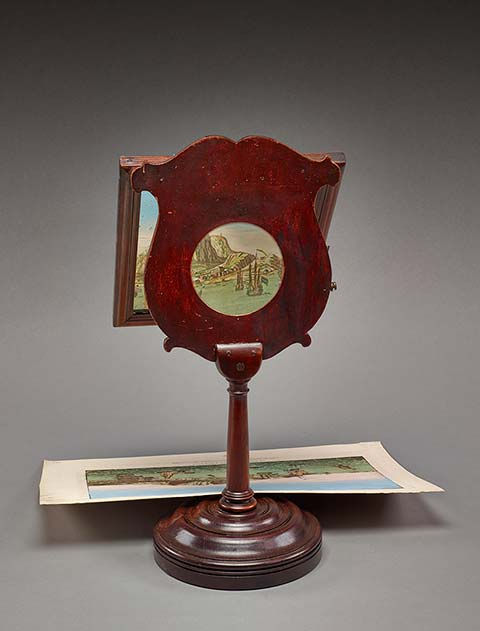
Blake’s explanation of space proved very worthwhile in understanding the relationship, both physical and mental, between media and society. The physical object of the zograscope influenced how people defined “polite society”: the viewer stood alone in the comfort of their own home looking on the view created by the zograscope. It inherently created a detachment from the physical environment the user viewed. This formulated a mindset of how the individual should act when they were actually out in the physical world: remain detached from the environment to remain polite.
Lastly, Blake’s use of magazine advertisements as evidence of the zograscope’s popularity raises an interesting question: if it had not been advertised, would it have been as pervasive as a medium? Blake explained that these advertising choices directly impacted the use of the zograscope by “gentleman” and “polite society.” If reputable magazines had not advertised the zograscope, it may not have been used to map “polite society” in England.
I would have liked to see some analysis of how the zograscope was used on the Continent after the mid-eighteenth century. Blake hinted that it was not used to create “polite society” like it was in England, but she never explains its uses.
*NOTE: While I was re-reading over my notes for this article, all I could think about were those old View Master personal slide projectors I had as a kid. You would put in a circular slide with multiple scenes and flip through them with the click of a button. It’s a similar format to the zograscope because it is a highly personal experience, but it was not a three-dimensional image like that created by the zograscope. It might be interesting for a children’s museum to adapt the old View Master technology to create a personalized experience for kids who may not learn as well in a large group setting.
Featured image: View of the image create by the zograscope. From the Princeton University Graphic Arts Collection.


Comments